Mr. Donovan, you are one of my most favorite teachers because of the respect you showed to your students!! You made class fun and showed us learning didn’t have to be difficult. I tell my girls all the time to find the “fun” in school and that came from you! I especially appreciate the years we went to the science museum and saw your light show. I always mention those trips to my girls when we go back. 💕
- KBC (former student)
My response:
Thanks for the kind words. And I agree, you have to find the fun in school. That doesn’t mean you’re not working. All it means is that you’re enjoying the learning process more.
More about finding the fun in school:
Who doesn’t love a hands-on project in your science class? Getting students to change things up and look at things differently from reading the book is always helpful. So, “Go home and make a working model of a volcano. Build a toothpick bridge that can support ten pounds. Create a diorama of a cell that highlights each organelle that is accurate in relative size and shape. Build a Rube Goldberg Machine that has at least ten different energy interactions before it flips a light switch.”
These projects are essential. Not every student is as adept with a paper and pencil test. Many kids see things more clearly if it is tactile. Science concepts are better understood with a variety of applications. How boring would class be if it were present – practice – test, repeat? These projects are important. It is enjoyable and more effective learning when you see things in different ways.
Hands-on projects are thought to be fun. They are usually quirky and imaginative. I can guarantee your parents did not enjoy these assignments at all. And I am sure that you learned very little when you did them at home.
These types of assignments are designed to be different and thought-provoking, applicable examples of the ideas and concepts learned in class. They are alternative forms of assessment that I feel are essential in learning. They absolutely belong there. They do not belong at home, though. I never wanted to see how well Anna’s dad could make a volcano. It doesn’t matter at all if Tommy’s mom can apply the principles of tension and compression in building a bridge. And that’s what usually happens when these types of assignments are given as homework. It goes from expecting a well thought out, deep level expression of the material studied in class, to a desperate and stressful let’s-just-get-this-thing-done project made more by the parents and less by the kids. At home, the goal becomes completion. In class, the goal is understanding.
So keep the assignments, but NEVER have them come from home. The project should be done in class. While homework can be assigned to support researching ideas or collecting materials, all work needs to be done in the classroom.
One learns when making mistakes. If students are making the mistakes in class they can discuss things with project partners and the teacher. No learning is occurring if the mistake is at home with a deadline of getting something in tomorrow for credit. It’s always more about the journey than the destination. This is the most appropriate way to look at student projects.
There are many terms for this type of instruction. Cooperative education, project-based learning, experiential learning, inquiry-based learning, design-based learning, challenge-based learning, … The names change about every 10 years, but the goal is the same. Get kids to work together on a project and they will all benefit.
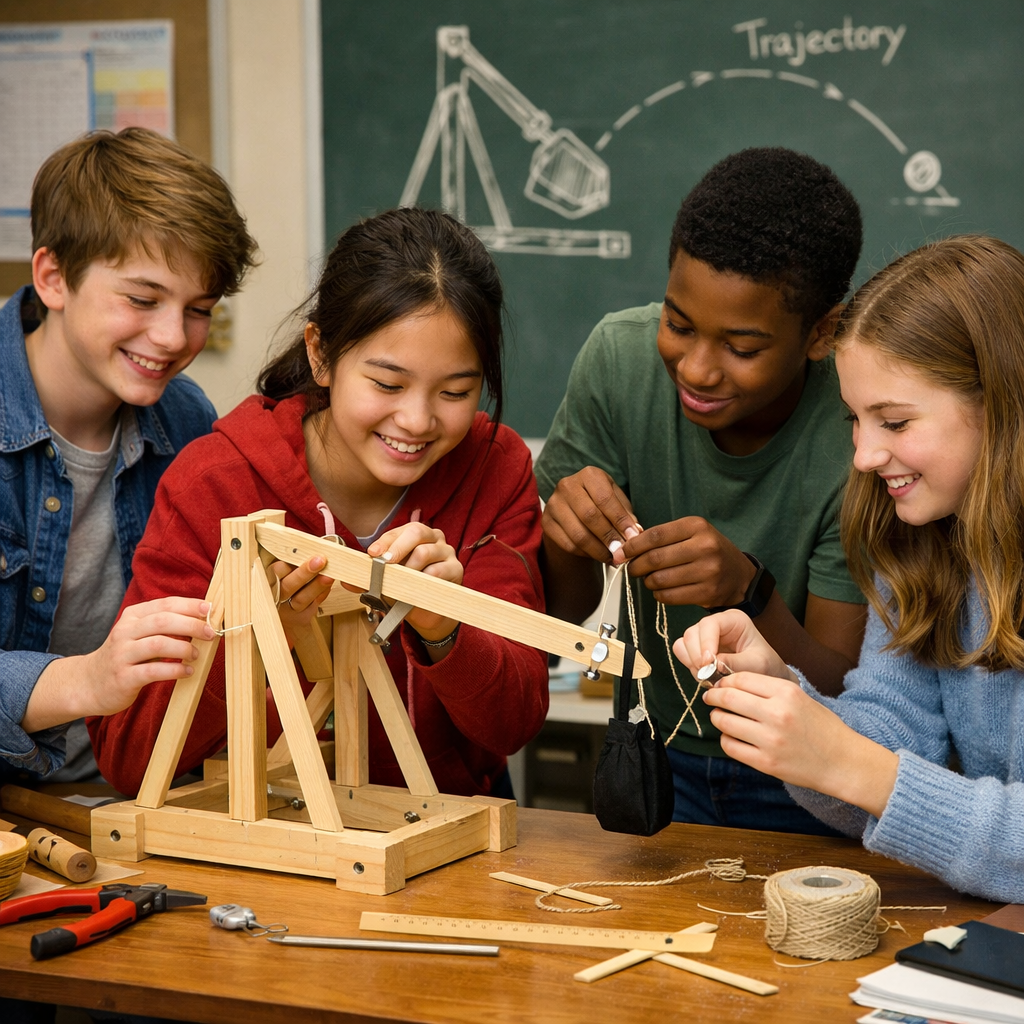
One of my favorite projects when studying energy with ninth-graders was making table top trebuchets. (Even having an alliterative title made me happy.) As the students were learning about energy transformations like gravitational potential to kinetic, they were asked to apply these ideas by making small catapults.
We would introduce the idea by showing an old video from NOVA- Secrets of Lost Empires: Medieval Siege. (https://www.youtube.com/watch?v=VmekblMdKtY). In it, they created medieval siege engines reported to have been used in the late 13th Century by Edward the First. In the video, modern day builders made life-size trebuchets modeled after “Warwolf”, the largest trebuchet of its time, during the siege of Stirling Castle in Scotland in 1304. Flinging flaming pianos across Shropshire was only one of the many highlights in the show. With that as their inspiration, students were tasked with making tabletop versions of Warwolf, or their own designs using popsicle sticks, duct tape, string, and wire hangers.
This assignment went through many iterations. We tried using toothpicks, hot glue, gum drops, pasta, masking tape, dental floss, … We launched little lego people, washers, bolts, … The teachers learned something new every year. Which is as it should be. No lesson is perfect. Things always have to evolve.

The assignment was four days long officially and would usually stretch into six. The entire project had a total score of 60 points and here is how it was graded:
- Concept Sketch and Plan Sheet: (10 pts)
- Testing Reflection Form: (20 pts)
- Trebuchet meets required elements: (5 pts)
- Mass limit not exceeded (-1 pt for mass between 100 g and 110 g, -2 pts for mass greater than 110 g)
- Construction completed on time and ready to launch when called
- Performance (5 pts)
- Teams ranked by distance thrown on best of 3 throws on testing day
- Farthest = 5 pts.
- 2nd farthest = 4 pts.
- 3rd farthest = 3 pts.
- Rest of the class = 2 pt.
- The final trebuchet must be durable. It stands freely with no obvious sagging or collapsing. The lever arm swings freely. It is able to launch 3 times without self-destructing. Trebuchet stays up after launch on best throw. If it falls over = 40% penalty on the distance. Example – your trebuchet flings the projectile 20 feet. If it falls over, your throw distance is reduced to 12 feet.
- Calculations and follow-up questions sheet (20 pts)
Notice that performance only counts for 5 of the 60 points. Again, it’s the journey, not the destination. It is more important the students show that they are thinking about and testing different concepts during construction and refinement. The reflection form is ⅓ of the grade. The same goes with calculations and follow-up questions. It’s more important that they be able to communicate why something worked or didn’t work.
I also included an extra credit portion to this assignment. Once everything was done I would have the kids make an eight foot wide row in the middle of the room. They would line up the tables and set their trebs up to fire across this aisle. I would put on safety glasses and a helmet and start walking slowly up and down the aisle for three minutes. Each group earned a point for every time they were able to hit me with a projectile from their trebuchet.
What other projects could you do in class?
- Make rube goldberg machines. (Think of the game, Mousetrap.)
- Building toothpick bridges.
- Building towers made only from one sheet of newspaper that has to support a weight at the top
- Mousetrap driven cars
- Egg drops
- Build solar ovens
- Have a debate about GMOs, or gas vs. electric cars
- Make bottle rockets
- Create models of the cell
Each project must focus on the process, though. It’s not which one goes furthest/ highest/is most accurate/protects. It is being able to answer why it did or didn’t do what you had originally planned. The best projects aren’t the ones that go the farthest. They’re the ones where students can explain why they didn’t.
Notice that each of these projects also has some competition between the groups. This is often a driving force for each group to do the best they can! While a teacher’s goal for the class is deeper understanding, sometimes the students’ goals are just to win. They are thinking short term while the teacher uses their competitive nature for the long term.


Leave a Reply