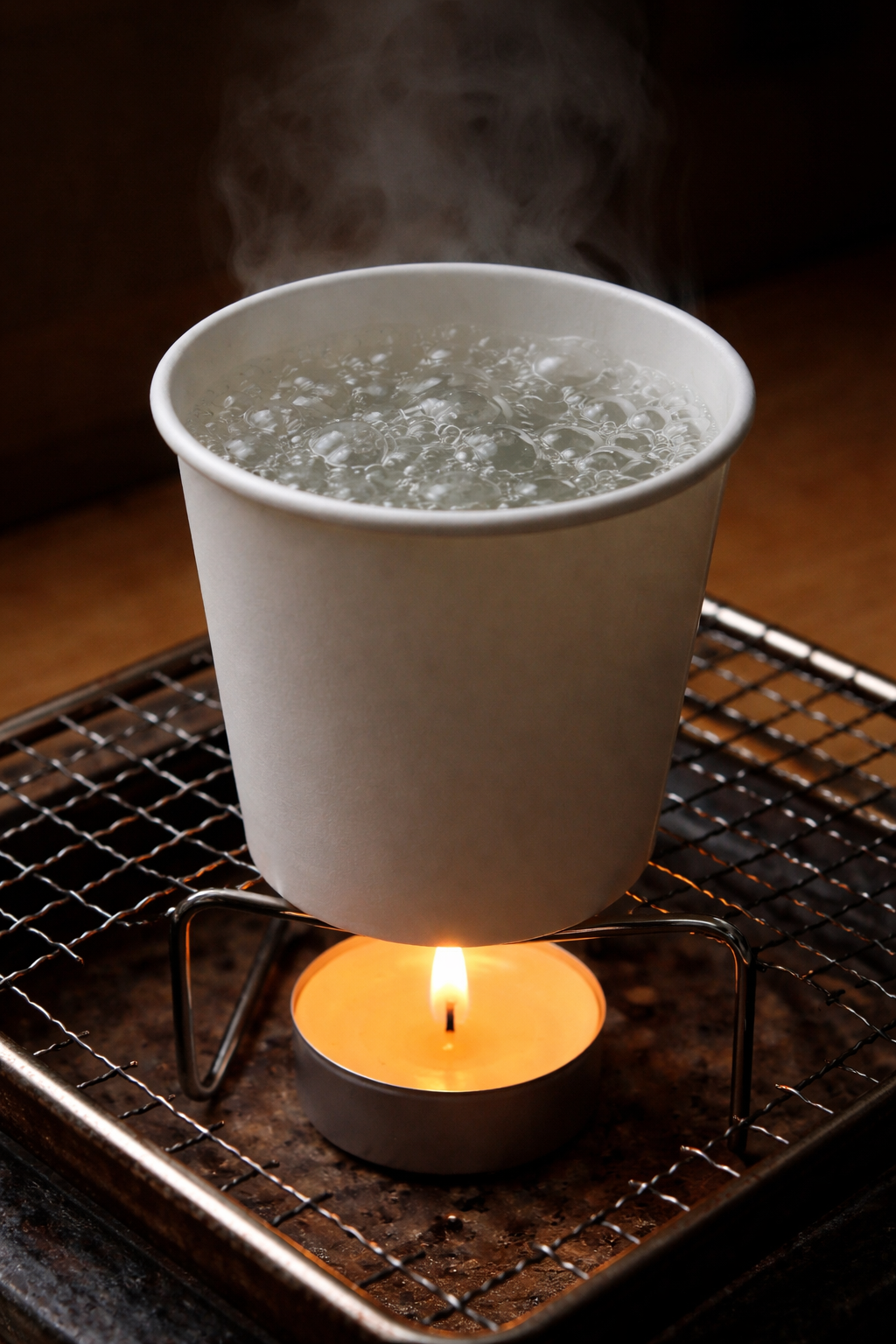
The joy of seeing a discrepant event, and then learning how physics explained it.
J.K. (Physics teacher at a rival school)
My response:
As we know, Physics is cool! Nothing more fun to me than boiling water in a paper cup! Thanks for contributing and here’s to a better 2021.
More on discrepant events:
A discrepant event is an observation that goes differently than one would originally expect. Even when people have studied the physics, their expectations of the outcome are different. They are great to use in physics to solidify a lot of concepts like heat, air pressure, center of mass, optics,…
They are useful in teaching because they can break down student preconceptions and allow them to describe events in a more ordered, scientific approach.
As one example- Can you boil water in a paper cup? Water is an incredible heat sink, boiling at 100°C (212°F). The temperature at which paper burns (its flashpoint) is 233°C (451°F). Paper is also capable of conducting heat. When you put a paper cup of water over a candle flame, the paper conducts the heat to the water quickly enough that it doesn’t reach its flash point. It will only burn where water is not touching it.
Anyone who has tried to light a fire using wet wood has experienced this. Yet most people are amazed at seeing water being boiled using a paper cup. Your experience there says paper burns easily, don’t put a flame to it! This allows a person to better understand the heat capacity of water.
There are other versions of this demonstration. (I refrain from calling them tricks!)
- Put a small amount of water in a balloon. Fill the rest with air. Hold the balloon over a friend’s head and spark a lighter to the bottom of the balloon.
- Soak a dollar bill in a 50% water, 50% alcohol solution. Holding the bill with tongs, light it on fire. The alcohol’s flashpoint is about 23°C (72°F). It burns, but the bill doesn’t.
Another example of a discrepant event is putting a balloon in a bottle. Take a small mouthed glass bottle and a balloon inflated to a size about two times the bottle opening. Try to push the balloon into the bottle. Try any way you can and it still won’t go in. Now light a small piece of paper and place it in the bottle. Once the flame is out, quickly place the balloon onto the mouth of the bottle. You’ll see it continue down until it’s in!
The hot air from the burning paper is less dense and moves more than the cooler air. So once it started to cool again, the air in the bottle moved less and exerted less pressure than the atmospheric pressure outside of 103 kPa (~15 lb/in2). So the balloon is pushed into the bottle by the greater pressure outside.
Now, how do you get the balloon out? This is where discrepant events really help define a scientific concept. Once a person has agreed that it’s the outside air pressure that pushed the balloon into the bottle, they should be able to conclude they need greater pressure inside the bottle to push the balloon out. Place a straw in the bottle with the balloon sealing the opening. Blow into the straw and remove it quickly holding the bottle upside down. The greater pressure (more air) in the bottle pushes the balloon out!
So why are discrepant events so useful in learning? Everyone comes into a classroom with their own set of ideas, experiences, preconceptions, … They have experienced the world in their own way, and make conclusions and assumptions from those experiences. This is true whether you are a six year-old starting first grade or a sixty year-old joining a book club. Many ideas that people have are incorrect not because they are not good thinkers or observers. They can be wrong because the explanations created do not take into account experiences a person hasn’t had. These preconceptions have served them well.
Aristotle (384 BCE – 322 BCE) is famous for being the epitome of great thinkers, but he got some stuff wrong, too! Does that mean his contributions weren’t important? Of course not. His philosophies were shaped by keen observations and discussion available to him at the time. Had he been capable of measuring things as accurately as Galileo or Brahe or Newton, I am sure he would have come to better descriptions of motion, the elements, and evolution that we take for granted today.
Some examples of common misconceptions are:
- There is no gravity in space.

People can see astronauts on the International Space Station floating freely. It looks like they aren’t anchored by gravity at all. But think about it more deeply. How is the space station orbiting Earth? How is the Moon orbiting Earth? Why does Earth orbit the sun? The answer is gravity.
Astronauts are actually being pulled towards the center of the Earth with a strength that is 88.5% what we feel on the surface of Earth (8.67 N/Kg vs 9.8 N/Kg). It looks like there is no gravity because the astronauts, the equipment in the station, and the station itself are all moving at this acceleration. So relative to each other, they don’t see its effect. It’s like when you are in an airplane with a cup of ginger ale sitting on the tray. Since you are both travelling about 600 mph, the cup is motionless compared to you.
So how can this be seen as a discrepant event? Poke two holes on opposite sides near the bottom of a two liter bottle and cover them with tape. Fill the bottle with water. You are going to drop the bottle from a height- maybe from the top of a ladder or fire escape. When you pull the tape off water will start to stream out of the bottle. Everything (the bottle and the water) is being pulled by gravity. But you are also pulling the bottle up so that effect gets canceled. All you see is the water going out of the bottle to the ground.
Now drop the bottle. When both the bottle and the water have ONLY gravity working on them their motions are zero relative to each other. The water stays in the bottle since as it is falling, the bottle is too, and at the same rate. They are “weightless” compared to each other.
- Seasons are caused by Earth being closer to or farther from the Sun.

Science is all about having the simplest explanation for observations. It’s warmer in the summer. The simplest explanation is that the heat source is closer. When you walk away from a fire you feel colder. It makes perfect experiential sense that when the sun is a little closer to us we experience summer, and when it’s a little further it’s winter. This explanation fits perfectly with most people’s life experiences- especially those that haven’t traveled much.
By the way, it is closer and further throughout the year. The earth doesn’t travel around the sun in a perfect circle. Aristotle thought that, but better measurements contradict him. The earth travels around the sun in an ellipse with one focal point on the sun. When the earth is closest (at perihelion) it is about 147.1 million Km (91.4 million miles) away. When it is furthest (at aphelion) it is about 152.1 million Km (94.5 million miles) away. That is a difference of 5 million Km (3 million miles), or a 3% difference.
When a person is camping they will sit about 1.5 m (4.9 ft) away from a fire. A 3% change in their location would be 4 cm (1.6 in) closer or further. That is about the length of a LEGO brick. Do you think there is an appreciable difference between 1.46 and 1.50 m? Maybe that 3% (or 6% between summer and winter) is enough? It’s not. The difference of the amount of sunlight between summer and winter in the Boston area is 260%. It is less near the equator, ~10%. And it is incredibly huge at the poles! And another problem with the closer/further explanation is that when it’s summer in Boston it’s winter in Santiago, Chile. So if it’s caused by the sun being closer, why wouldn’t they both have summer?
And we haven’t even talked about how the height of the sun changes through the year as well as how long daylight is. These observations have to be factored in, too. The real reason we have hot summers and cool winters is that the sphere that is the earth is tilted at an angle of 23.5° from a right angle to the ecliptic. The ecliptic is the line drawn from the center of the sun to the center of Earth. That line hits the Tropic of Cancer on the first day of the Northern Hemisphere summer and the Tropic of Capricorn on the first day of the Northern Hemisphere winter. When talking about the Southern Hemisphere I would just switch the seasons.

This tilt allows for more direct sunlight hitting the Northern Hemisphere for a longer amount of time from March 21-Sep 21. And the sunlight arrives at a lower angle, for less time from Sep 21- Mar 21, making it weaker. Those dates should be familiar as the first days of Fall and Spring (Autumnal and Vernal Equinox). On those days the amount of light is the same in each hemisphere. It is just that one is getting colder (Fall) and the other is getting warmer (Spring).
So how can you see this as a discrepant event? Get a globe or even a ball with lines on it for the equator. Hold it up to a single light source like a flashlight from across the room. When you tip the ball towards the light at an angle from straight up you will see more of the top half is in the light. If you tip the ball away, more light shines on the bottom half.
Just a few more misconceptions that can be tested. Just maybe not in your living room.
- Bulls get angry when they see red. Bulls are color-blind to red; it’s the *movement* of the matador’s cape that provokes them.
- Lightning never strikes the same place twice. The air is actually primed to do a better job hitting the same thing. More about lightning, and what can go wrong, later.
- Humans evolved from apes. Humans and apes share a common ancestor and evolved along separate branches from that ancestor millions of years ago. It is better to say humans evolved with apes. They are our cousins, not our grandparents.
- Heavier objects fall faster than lighter ones. You’ll learn more about this later with the pumpkin drop.
- Bacteria are bad. Most bacteria are harmless and many are beneficial. They help you digest food, make vitamins, and support ecosystems.
Leave a Reply